
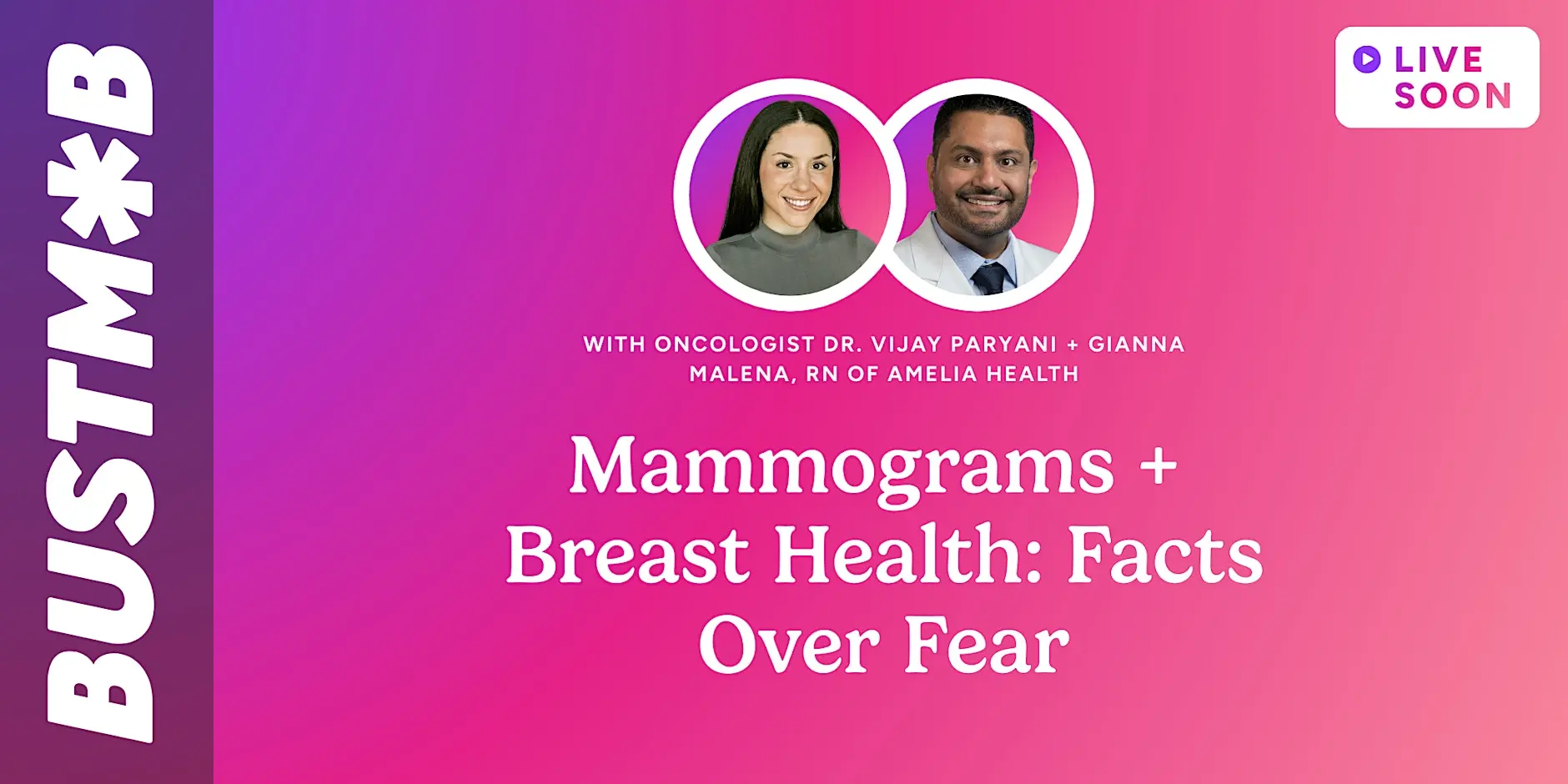
Facts Over Fear
There are a lot of conversations happening in the Bustmob Community (a supportive all-women, plastic surgery community) around breast health, breast implants, and mammograms. We also know that some of the information out there can feel overwhelming…and sometimes scary.
We recently hosted Dr. Vijay Paryani a trusted oncologist in Raleigh, North Carolina and Gianna Malena, RN of Amelia Health (also in Raleigh, NC) for a Bustmob Live about all things breast health, implants, and mammograms.
As always, our goal with this conversation is simple: to make sure you have access to clear, accurate information so you can make informed decisions about your health. This is not medical advice, but it is an opportunity to walk through common questions, address myths, and better understand how screening works.
Because at the end of the day, early detection is one of the most powerful tools we have.
What is a mammogram?
A mammogram is a specialized X-ray of the breast that can detect cancer early, often years before you would ever be able to feel a lump.
During the exam, the breast is gently compressed between two plates while images are taken. That compression helps create a clearer picture and actually allows the use of less radiation.
There are two main types:
- 2D mammography, which takes a flat image
- 3D mammography (tomosynthesis), which takes multiple images from different angles to create a more detailed view
Today, 3D mammography is considered the gold standard. It has been shown to find more cancers and reduce false alarms.
When should you start getting mammograms?
Guidelines vary slightly across organizations, but most are aligned around the same general recommendation:
- Start screening at age 40
- Continue annually
Some organizations suggest every two years, but many specialists favor a yearly approach, especially given that people are living longer and healthier lives. If you have additional risk factors, like a strong family history, you may need to start earlier, sometimes up to ten years before the age at which your youngest relative was diagnosed.
What happens if you skip screening?
This is one of the most important points to understand. Large studies have shown that women who skip mammograms have a significantly higher risk of dying from breast cancer. One recent study of 400,000 women found:
- A 40% higher risk of death from breast cancer
- A 53% higher likelihood of being diagnosed at Stage 3
- A 261% higher likelihood of being diagnosed at Stage 4
The key distinction is this: Mammograms do not prevent cancer. They are meant to detect cancer early, when it is smaller, easier to treat, and more likely to have a good outcome.
Are mammograms safe? How much radiation is involved?
Radiation exposure from a mammogram is very low.
- The average person receives about 3 millisieverts of natural radiation each year just from everyday life
- A single mammogram is about 0.4 millisieverts
That is roughly equivalent to a few cross-country flights or several weeks of normal environmental exposure. When you compare the very small theoretical risk of radiation to the number of lives saved through screening, the benefit is overwhelmingly greater.
What are dense breasts?
Breast density refers to the amount of glandular and connective tissue compared to fat within the breast.
- It is determined on imaging, not by how your breasts feel or look
- Over 40% of women have dense breast tissue
Dense tissue appears white on a mammogram, and so do cancers, which can make detection more challenging. It can also be associated with a slightly increased risk of breast cancer. Because of this, some patients with dense breasts may benefit from additional screening, depending on their overall risk.
What are breast calcifications?
Calcifications are tiny calcium deposits that appear as small white spots on a mammogram. They are extremely common, and the majority are benign.
However, certain patterns, especially fine, clustered calcifications, can be an early sign of cancer. These are not something you would ever be able to feel, which is why mammograms are so important. They can detect changes at a very early, highly treatable stage.
Can you get a mammogram with breast implants?
Yes. Mammograms are absolutely still recommended if you have breast implants.
The process includes:
- Standard images
- Additional implant displacement views, where the implant is gently pushed back and the breast tissue is pulled forward
This allows the radiologist to see more of the breast tissue clearly. The displacement is temporary and does not affect the implant long-term.
Can mammograms rupture implants?
This is extremely rare. In large reviews of implant-related reports, only a very small number of ruptures were associated with mammograms, and it is often unclear whether those implants were already compromised.
Breast implants are designed to withstand significant pressure, far more than what is used during a mammogram. When weighing risks, the likelihood and seriousness of undetected breast cancer far outweigh the minimal risk of implant damage.
Should you get a mammogram before or after surgery?
This depends on your surgeon and your individual situation.
- Some surgeons recommend a baseline mammogram before surgery, especially if you are close to your screening age
- After surgery, many recommend waiting 3 to 6 months to allow healing before imaging
This is something that should be discussed directly with your surgical team.
Can ultrasound or MRI replace a mammogram?
MRI and ultrasound are valuable tools, but they are not replacements for mammograms.
- MRI (with contrast) is very sensitive and often used in high-risk patients, but it cannot detect calcifications well
- Ultrasound can help evaluate specific areas but is not as effective as a primary screening tool and depends on the operator
For average-risk patients, mammography remains the primary screening method because it is the only one proven to reduce mortality.
Is thermography better than mammogram?
Thermography uses infrared imaging to detect heat patterns, but it is not an effective screening tool.
- It has not been shown to save lives
- It can miss a significant percentage of cancers
- It cannot detect calcifications
- It is not recommended by major organizations like the FDA, American Cancer Society, or American College of Radiology
It should not be used as a substitute for a mammogram.
Do breast implants cause cancer?
No. Breast implants do not increase the risk of breast cancer. There is a rare condition called Breast Implant-Associated Anaplastic Large Cell Lymphoma (BIA-ALCL), but:
- It is not breast cancer
- It is extremely rare
- It has primarily been associated with older textured implants that are no longer widely used
- It is typically very treatable when identified early
What to do if you find a lump in your breast
Call your doctor. Most lumps are benign, but any new lump should be evaluated. This usually involves imaging such as a diagnostic mammogram and ultrasound, and sometimes a biopsy if needed.
Delaying evaluation out of fear, whether related to implants or anything else, is not recommended.
Should you be doing self breast exams?
Many organizations now emphasize breast awareness rather than strict monthly self-exams.
This means:
- Understanding what is normal for your body
- Noticing changes such as lumps, skin changes, nipple changes, or discharge
If something feels different, it is always appropriate to have it evaluated.
Final Thoughts
Breast cancer remains a significant health issue, affecting approximately one in eight women. Screening does not prevent cancer, but it allows for earlier detection, which can significantly improve outcomes and reduce the need for more aggressive treatment.
The most important takeaway is this: Mammograms save lives. Implants do not prevent you from being screened, and the concerns that often circulate do not hold up against the evidence.
If you have questions, ask them. If something feels different, have it checked. And if you are due for screening, prioritize it.
Love learning from the experts?
Check out our upcoming Bustmob Lives and save your spot for free.